In 2021, Kwabena Boahen Asare found himself in at the deep end when he joined a skin cancer laboratory to gain hands-on research experience.
For Asare, who was a first-year undergraduate student at Dartmouth College in Hanover, New Hampshire, at the time, it was an exciting but daunting prospect. Not only was he the sole bachelor’s programme student working alongside senior researchers with years of experience under their belts, he was also the only Black person in the lab. Although Asare’s mentor and colleagues were supportive and encouraging, he felt overwhelmed and out of his depth. “There was a steep learning curve,” he says.
At the time, Asare viewed his struggles as a sign that he didn’t belong in research. This feeling was compounded by the fact that he was surrounded by colleagues who didn’t share his background as a first-generation student from Ghana.
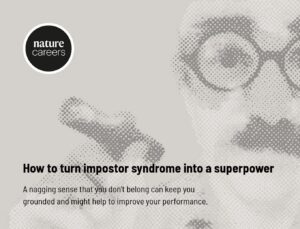
His experience, and those of many like him, is commonly labelled as impostor syndrome — the fear of not being as competent or knowledgeable as other people think, despite objective accomplishments. In a world that often prizes unflinching self-confidence and boldness, impostor syndrome is usually cast as a psychological flaw that the individual needs to ‘fix’. But it can be a natural response to working in a challenging environment or striving towards an ambitious goal, organizational psychologists say.
Impostor syndrome can also be a reaction to systemic bias and exclusion in the workplace, particularly for people from under-represented groups, including women, says Ruchika Malhotra, an inclusion strategist and founder of Candour, a workplace consultancy in Seattle, Washington. The company advises organizations on strategies to create diverse teams and inclusive cultures. One study conducted at universities in the United States found that women who work in scientific fields that particularly value intellectual brilliance are more likely to feel like impostors than are their male colleagues.
Much of the discussion about impostor syndrome pathologizes healthy self-doubt and shifts the responsibility onto individuals instead of the environments that exclude and marginalize them in the first place, adds Malhotra. “A lot of the ways that it’s been talked about haven’t been constructive,” she says.
Although it comes with drawbacks, in some situations, impostor syndrome can be beneficial. For instance, it can help people be better prepared and more focused, particularly when they have a long to-do list.
“Impostor thoughts are almost like your superpower when things get pretty overwhelming.”
Basima Tewfik, an organizational psychologist who studies impostor syndrome at Massachusetts Institute of Technology in Cambridge
Looking back, Asare says that his impostor syndrome prompted him to reflect on why he wanted to become a researcher in the first place. It has also made him more conscious of his resilience, how he needs to improve and when to seek help, as well as giving him more empathy. This has made him better able to support younger students and researchers who are feeling out of place. “It became my strength,” says Asare, who is now an oncology researcher and consultant at Dartmouth Hitchcock Medical Center in Lebanon, New Hampshire.
Blurry picture
Impostor syndrome was first described as ‘impostor phenomenon’ in a 1978 paper on high-achieving women co-authored by psychologists Pauline Clance and Suzanne Imes, both then at Georgia State University in Atlanta. They wrote that people who experience this phenomenon “maintain a strong belief that they are not intelligent; in fact they are convinced that they have fooled anyone who thinks otherwise”.
In the decades since, impostor phenomenon has morphed into a syndrome, even though it isn’t a medical diagnosis, nor is it classified as a psychiatric disorder. A review published in 2023 suggests that around 70% of people will feel unworthy of their accomplishments at some point in their lives. These feelings are even more prevalent in academia, with a 2012 study finding that as many as 82% of graduate students experience impostor syndrome to at least some degree. This pattern of thinking often affects high achievers and is associated with lower job satisfaction, hindered performance and burnout. Although some studies, including the 2012 paper, suggest that impostor syndrome affects mostly women and people from other groups under-represented in academia, others argue that it arises in specific situations rather than among particular groups. Relatively few studies have investigated whether commonly cited strategies, such as listing one’s accomplishments and accepting compliments from others, are actually effective.
70%
of people will feel unworthy of their accomplishments at some point in their lives (2023 review)
82%
of graduate students experience impostor syndrome to at least some degree (2012 study)
Impostor syndrome has become a catchphrase in popular culture, with dozens of articles, books and courses describing what it is and how people can overcome it. But in the scientific literature, at least, the exact definition of impostor syndrome, or phenomenon, varies widely. This has created a murky picture of what it really is and how it affects people, says Tewfik. “There are a lot of different ways people describe this phenomenon,” she says. The loose definition has made it easy to confuse impostor syndrome, which causes people to make inferences about what other people think of them, with regular self-doubt, which is more of a personal reflection of your own capabilities, according to Tewfik.
Much of the research on impostor syndrome has also used measures that have made it difficult to distinguish from other psychological patterns, such as negative affectivity, a personality trait that is linked to a tendency to experience negative emotions such as fear, anxiety and insecurity, adds Tewfik. This crossover might explain why most studies on impostor syndrome have shown only negative outcomes, such as a lack of career planning and low motivation to lead. “It’s possible that what we’ve been studying is actually something much more akin to fear,” says Tewfik.
This overly negative slant is exacerbated by the fact that many workplaces, including academic ones, place too much emphasis on self-confidence, says Tomas Chamorro-Premuzic, an organizational psychologist at University College London. One 2024 study found that workers who display confidence are perceived as more competent and dominant, irrespective of their actual ability.
If impostor syndrome hinders a person’s ability to work or form relationships, it’s usually a symptom of a deeper issue or clinical condition, such as an anxiety disorder. But feeling like you’re about to be ‘found out’ before delivering a big presentation, for example, is usually a sign that you’re being challenged or working outside your comfort zone, says Chamorro-Premuzic. “There is a very healthy degree somewhere that we’re not appreciating,” he adds (see ‘A toolkit for working with impostor syndrome’ below).
In scientists, impostor thoughts can simply be a by-product of thinking critically and approaching things with a healthy dose of scepticism, says Samantha Sutton, an independent career coach for scientists in Boston, Massachusetts. It’s also often a natural response to working in a high-achieving, competitive environment or towards an ambitious goal and should be normalized instead of treated as a problem to solve, she adds. “If you’re up against something big, you should be scared,” says Sutton. When she communicates this to her clients, they are often relieved to hear that they don’t need to strive for total self-confidence before taking steps towards their goals. “They realize that nothing is wrong,” adds Sutton.
“If you’re up against something big, you should be scared.”
Samantha Sutton, career coach for scientists
Silver lining
Although feeling like a fraud comes with its downsides, it does confer some advantages. In 2022, Tewfik asked trainee physicians to rate how often they experienced “impostor thoughts”, such as thinking that people overestimate their capabilities at work. She found that those who grappled with these thoughts most often were perceived as having better people skills than were trainees who experienced such thoughts less frequently. For instance, physicians with frequent impostor thoughts made more eye contact with their patients and shifted the tone of their voice to sound more caring. They were just as competent as physicians who experienced fewer impostor thoughts, the study found. There was no relationship between frequent impostor thoughts and race or gender, although the sample size was small, adds Tewfik.
In a study published in April, Tewfik also observed that impostor syndrome can enhance performance in some situations. She found that workers who experienced impostor thoughts frequently pushed themselves harder when they were time-strapped and had an overloaded to-do list. This extra effort didn’t seem to have a negative impact on the workers’ wellbeing. Meanwhile, employees who experienced impostor thoughts less often exerted less effort when they had too much to do, which ultimately hindered their performance.
Another benefit of feeling like you’ve fooled everyone into thinking you’re better than you are is that it helps you prepare well, which in turn leads to higher-quality work, says Chamorro-Premuzic. He adds that impostor syndrome keeps people grounded and prevents them from overestimating their abilities. “You’re going to come across as more humble and sometimes more self-aware than the majority of people who think they’re amazing when they’re not,” he says.
Reap the benefits
Whether you can take advantage of impostor syndrome depends on your mindset, Tewfik’s research suggests. In work presented at the Annual Meeting of the Academy of Management, in Philadelphia, Pennsylvania, in July and currently under review, she said that if people approach their impostor thoughts as a sign to “rise to the occasion”, the feelings can act as an impetus to focus more sharply on a given task, enhancing creativity. But if people view such thinking as a reminder that they don’t measure up, they spend more time ruminating and getting distracted, spelling doom to creative thinking.
Rather than aiming for total self-confidence before acting, which is unrealistic and leads to frustration, it can help to approach impostor thoughts with a growth mindset — reframing challenges and failures as opportunities to learn, says Sutton. This can help people to build resilience and move towards their goals even when they’re questioning their abilities or fear that they don’t belong, she adds. “Most of us can learn to live with a little bit of fear.”
Although society tends to view fear and self-doubt as entirely negative, it’s worth remembering that these emotions are important for keeping us safe. Meanwhile, too much confidence can land people in dangerous situations, so the aim should be to find a healthy balance instead of listening to one voice over the other, Sutton adds.
Another way to avoid falling prey to the negative side of impostor syndrome is to become indifferent to it, says Chamorro-Premuzic. It’s also a good idea to be aware that other people’s perceptions of your capabilities hold more weight than your own assessment, he adds. Research has shown that other people are better at predicting your strengths and weaknesses than you are. “If you don’t think as highly of yourself as you should, maybe other people think really highly of you,” says Chamorro-Premuzic.
For Asare, meeting other researchers with similar backgrounds and levels of experience helped him to realize that his impostor syndrome was a normal side effect of the challenging environment that he found himself in. These days, he thinks that the experience helped him to become a better researcher. “It’s given me that sense of confidence,” says Asare. “I wake up, go do my best and I never think about not being good enough.”
Toolkit
A toolkit for working with impostor syndrome
1 · Recognize your feelings
If listing your accomplishments and reciting positive affirmations into the mirror have left you feeling frustrated, it might be more helpful to acknowledge your impostor feelings for what they really are: fear, says Samantha Sutton, an independent career coach for scientists in Boston, Massachusetts. Although such feelings are uncomfortable, it’s worth remembering that they are a signal you are stretching yourself rather than evidence that you’re incapable, she adds.
2 · Lower the volume
Fear and self-doubt have an important role in keeping you safe from legitimate dangers. The problem starts when they become the loudest voices in your head, says Sutton. To avoid becoming flooded with your feelings, it can be useful to name them or even make them into characters, such as Doubting Debbie or Judgemental John, she says. This can help you to detach from your emotions enough to keep moving towards your goals without waiting until you feel 100% confident.
3 · Talk to others
It’s tempting to stay quiet about feeling like a fraud, but talking to others can normalize your feelings, enabling you to realize that you are not alone, says Helen Willcock, a polymer scientist at Loughborough University, UK. For instance, Willcock has one colleague who she can empathize with before daunting meetings. “We’ll stand outside the room and say, ‘I have no idea what I’m doing’,” she says. “It’s really nice to have those people.” It’s also worth asking supervisors and colleagues for honest feedback on your performance to “calibrate how you’re assessing yourself”, says Tomas Chamorro-Premuzic, an organizational psychologist at University College London.
Read more: for more on this topic, read about how I overcame impostor syndrome after leaving academia and our 4 tips to ward off impostor syndrome.
Shared from Nature Careers, written by Gemma Conroy. For the original and more great content visit: doi: https://doi.org/10.1038/d41586-026-03465-6


 Dementia Researcher
 Nature Careers Blog

 LSE Impact Blog
 Heather Wilkinson