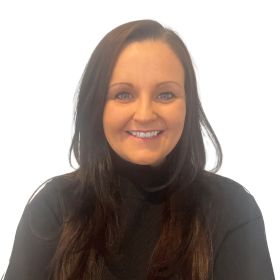
Professor Fiona Ducotterd
Fiona Ducotterd’s career in drug discovery and development has predominantly been in the global pharmaceutical industry in the UK, Japan, China and the USA. She returned to academia as Chief Scientific Officer at the Alzheimer’s Research UK UCL Drug Discovery Institute in 2022. In her current role, she applies her drug discovery and development experience to turning new biological discoveries in dementia into potential treatments. Breadth of technical and operational expertise, and learning across disciplines, sectors and cultures, have shaped her leadership.
“Remember to enjoy the now alongside having your eye on what is next.”
My route into research
I graduated with a BSc (Hons) in Molecular Biology from the University of Edinburgh in 2005. During an industrial placement at MSD in 2003–2004, I worked on Alzheimer’s disease and gained hands-on experience in electrophysiology and histology. My granny also had Alzheimer’s at the time. That very personal connection to my lab work, the absence of treatments and the teamwork of drug discovery convinced me that this was the career I wanted.
From 2005 to 2008, I studied full-time for a neuroscience PhD in Newcastle. My project, “Gamma Oscillations in the Rat Basolateral Amygdala In Vitro”, built on the electrophysiology experience I had gained during my placement and final-year project. It gave me a technical foundation for the roles that followed.
Moving between countries and sectors
My postdoc took me to the Okinawa Institute of Science and Technology in Japan from 2008 to 2010. I enjoyed the laboratory work and learnt to adapt to a new culture and language, including relocating a laboratory to a new building in tropical heat. I also had a rich cultural experience outside work living in Japan and learnt to sail and scuba dive. The experience confirmed that, in the longer term, I wanted to return to translational science and drug discovery in an interdisciplinary team.
In 2010, I joined GSK in Shanghai as an electrophysiologist. I was back in industry and team-based research, while adapting to another country, language, culture and organisation. Contributing electrophysiology data across a wide range of projects in the portfolio, working in international teams and gaining more exposure to the later stages of drug discovery and development broadened my experience within an international matrix organisation. I was lucky to work alongside exceptional industry leaders who were also role models and champions from this early stage in my career. They have remained in my network, often as collaborators and lifelong friends and mentors.
Developing leadership experience
I returned to the UK in 2012 to work at Eisai as an electrophysiologist and project leader. Alongside embedding in a new organisational culture, I experienced the very real surprise of reverse culture shock on returning home to the UK. I expanded my scientific experience through projects involving small molecules and biologics. In 2014, I was offered the opportunity to move my lab to the USA discovery site in a restructure. My responsibilities grew through laboratory and project leadership and involved international collaborations with groups inside and outside the company, including academia, biotechnology and contract research organisations. I sourced projects and technologies, managed alliances and contracts, and learnt to work beyond scientific departments. I established an alliance function in our discovery team to support our significant external partnering activities. I became Head of External Innovation on the site leadership team and was US representative on the Global Open Innovation team.
From 2019 to 2021, I was Senior Director, Alliance Management and Interim Head of Alliance Management at Vertex. This was my first role wholly away from the laboratory and was a great opportunity to build expertise in new technologies and modalities and wider business development across a range of deal structures and transactions.
In late 2021, I established a preclinical and strategic partnering consulting firm, FireWire Consulting LLC, to support a range of biotechnology company clients from preclinical work to regulatory filings. I also became a mum in 2021.
Returning to the UK and academia
In 2022, I was offered the role of Chief Scientific Officer at the Alzheimer’s Research UK UCL Drug Discovery Institute back in London and I was excited by the scientific opportunities to translate new discoveries into treatments with industry infrastructure in the academic setting at UCL.
Leaving Boston for the role was a major decision, and the first international move I had made with a family to consider. We were happy and secure as a family in Boston, with good jobs, close friends and a support network, but we wanted our daughter to grow up nearer to our families.
Becoming Chief Scientific Officer at the Alzheimer’s Research UK UCL Drug Discovery Institute has meant moving into a new sector and offered significant opportunities for growth and development, seeing collaborations from the other side of the table after my time in industry. I have learnt a lot as an academic principal investigator, including how to apply for, receive and manage grants, which is vastly different from my experience of managing projects, portfolios, teams and budgets in industry. This cross-sector leadership experience has expanded my skills in cross-functional working and management in a new environment.
My current work
My laboratory collaborates closely with academics who have made discoveries about the biology and possible causes of diseases that lead to dementia and builds drug discovery projects around them. We aim to develop a range of treatments that could prevent or reverse the biological mechanisms leading to neuronal death and dementia.
Our week starts with a full-team laboratory meeting to share updates and discuss operations. I meet regularly with academic and industry collaborators. For each drug target in our portfolio, the multidisciplinary team reviews progress, deliverables, timelines and risks. One of my jobs is to remain connected with the ecosystem at UCL and across the UK to identify new drug target opportunities and also find technologies that can support our pipeline, which means I get to stay very close to the science around us. A highlight for me is the weekly UCL Neurogenetics laboratory meeting. Having direct access to the wealth of translational research and emerging discoveries across the Queen Square Institute of Neurology, from basic science towards clinical work, is exactly what attracted me to this role in academia. There is huge potential for translation.
Alzheimer’s Research UK provides core funding for our interdisciplinary team and the infrastructure needed for drug discovery, including specialist equipment and automation. We also have collaborative project funding that helps advance projects in the pipeline. Current collaborations have funding from major funders, including the UK Dementia Research Institute, LifeArc, the UCL Translational Research Office, the MRC and My Name’5 Doddie Foundation. We also work with a network of collaborators (researchers, consortia and companies) in areas such as technology platforms, data science, target validation, computational chemistry and disease models.
Challenges along the way
Several changes in my industry career came through company restructuring rather than personal choice. Each brought lessons and opportunities to broaden my skills and grow as a leader, but change is not always easy and you have to develop your agility to manage transitions. Moving countries means starting again in many ways, both professionally and personally, and doing that with a family adds pressure.
Taking things day by day and building and maintaining networks have helped. During uncertain periods, people in my network offered advice and encouragement, introductions and practical solutions in many cases. A support network can keep you on track when things are difficult and help you stay grounded and focused when opportunities arrive.
Skills and support
Technical expertise and awareness of the field are essential because the science and technology change quickly. Plans change too, so adaptability matters in leadership. Cultural awareness and balance have helped me work across countries, organisations and sectors.
Mentors, colleagues and friends have helped me move forward. I always remain open to learning, even when a course covers something I think I know already. Understanding the science from laboratory discovery towards clinical application, and learning beyond my own specialism, help me lead programmes and teams with a wide range of expertise.
What I find rewarding
Seeing science move forward as a result of my team’s integrated ideas and delivery is the most rewarding part of my work. Navigating the complexities of management and the organisation itself can be harder than people expect.
Looking ahead
Career development can come through formal training, informal learning and working with other people. Being open to challenge, challenging yourself and learning across sectors all matter. Expanding my range of experience has helped me continue developing as a leader.
Four practical lessons
- Be open to a broad range of opportunities, especially when options are scarce. A move beyond your original plan can build skills that become valuable later.
- Work with others and understand your strengths. Different perspectives help you see more than you would on your own.
- Identify what you want to improve, and use development opportunities to work on it.
- Give back. Never forget the times you needed help and the difference people made to you, and pay that forward to others. A kind or productive word from someone on a bad day can give you the energy to keep going.
Focus on what is going well and change what is not. Remember to enjoy the present while keeping an eye on what comes next.
Find out more
- Fiona on the process of drug discovery at UCL
- Fiona’s UK Dementia Research Institute profile
- Alzheimer’s Research UK Drug Discovery Institute at UCL
- Listen to Fiona in Make Your Mark: Elevating Your Academic Visibility
 Dr Yvonne Couch
 LSE Impact Blog